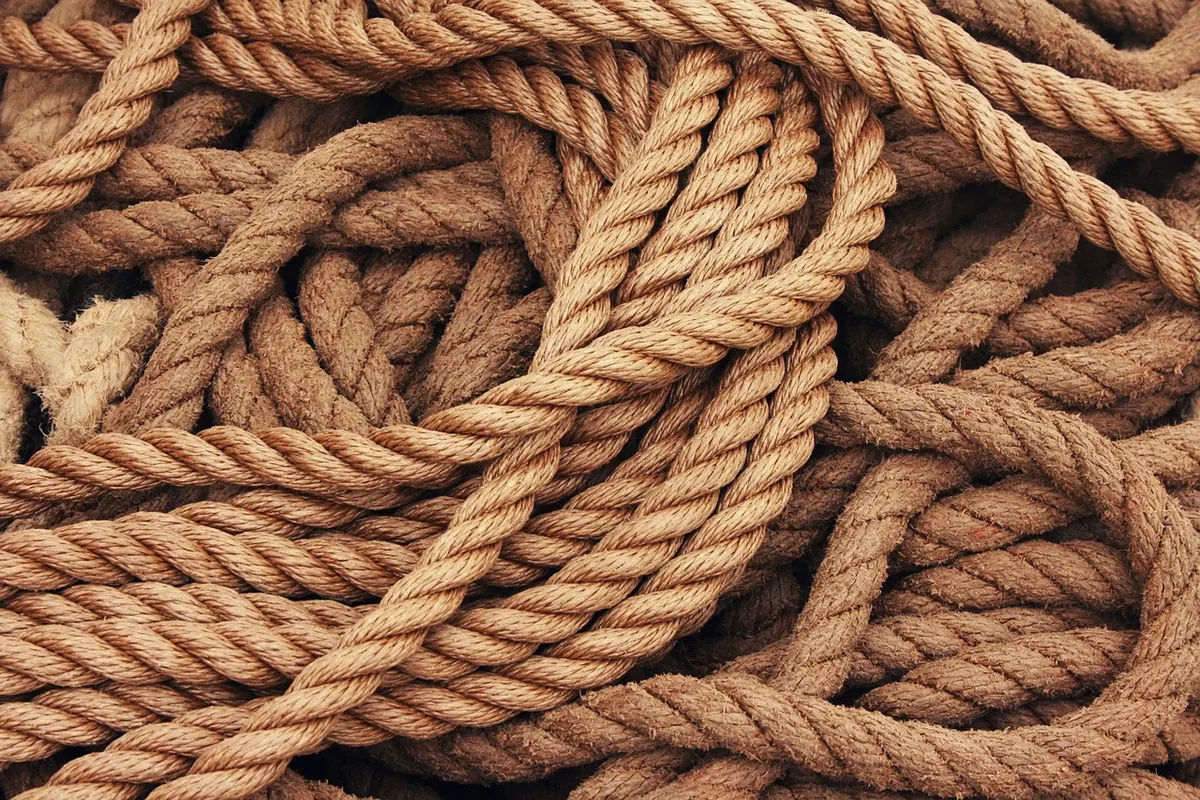
Pick up a length of good mill-twisted hemp cord and the first thing you notice is that it has a body. It is round rather than flat, it holds a curve, and when you roll it between finger and thumb the twist registers like a small ridge under the skin. That firmness is not an accident of packaging. It comes from the way fiber was beaten, spun and laid together by machinery driven by water, and it is the reason this kind of cord behaves so well under the hands of someone tying knots rather than splicing hawsers.
Understanding where that texture comes from changes how you choose cord, how you cut it, and how much you trust it in a finished piece. The mill is not a romantic detail. It is the reason the cord feels the way it does.
What "Mill Twine" Means Here
In the Italian craft vocabulary, a mulino was rarely a single-purpose building. The same water wheel that ground grain might also full cloth, pulp paper, press olives, or drive the machinery that processed hemp. In hemp country — the plains around Bologna, parts of Ferrara, the countryside behind Naples — mills were adapted to the brutal early stages of fiber work, then later to spinning and twisting frames with rows of hooks and spindles.
Mill twine, then, is not a brand or a grade. It is cord whose twist was produced by a driven frame rather than by a hand spindle or a crank turned by one person. That distinction matters more than it sounds. A water wheel delivers steady torque for hours, so every meter of cord receives roughly the same number of turns. Two-ply and three-ply cords came off these frames with a regularity that hand work struggled to match, and regularity is exactly what a knotted pattern needs.
From Stalks to Spinnable Fiber
Nothing about rope-making begins with rope. It begins with a field of tall, woody stalks and a long sequence of unpleasant jobs, most of them done before the fiber ever reaches a spinning frame.
- Cutting and drying. Hemp or flax is cut near the base and left to dry in bundles, stalks aligned so the fiber runs in one direction.
- Retting. Bundles are submerged in slow-moving water or laid out in dew for days or weeks. The point is controlled rot: the pectin holding fiber to the woody core breaks down, without the fiber itself degrading.
- Breaking. Once dry again, the stalks are crushed between fluted rollers or beaten with a wooden brake, shattering the brittle core into short pieces called shives.
- Scutching. The broken stalks are scraped or beaten so the shives fall away, leaving ribbons of fiber.
- Hackling. The fiber is drawn through combs of increasing fineness. Long, clean strands come through; short, tangled fiber is separated out and goes to coarser uses.
What survives all that is a bundle of parallel filaments with a slight roughness along their length. That roughness is the beginning of everything a knot tier cares about.
The Twist: Spinning, Plying, Laying
Fiber has almost no strength in a bundle; it needs twist. In spinning, the hackled fiber is drafted — pulled thinner — and twisted at the same time into a yarn. The direction of that twist is described as S or Z depending on which way the spiral leans, and it is chosen deliberately, because the next stage has to oppose it.
Yarns are then twisted together into strands, in the opposite direction to the yarn twist. Finally the strands are laid up into the finished cord, opposing the strands. Each level locks the one beneath it. This is why a properly made three-strand rope does not unravel when you cut it, and why a badly made one falls apart the moment tension is released.
The mill's contribution is consistency of lay — the number of turns per unit of length. A hard-laid cord is dense, round and resistant to abrasion; a soft-laid one is flatter, more forgiving and more inclined to flatten into knots. Italian mill cord tends toward the firmer end, which is part of its character.
A well-laid cord tells you its direction the moment you roll it between your fingers. Learn that habit before you cut anything.
Why This Texture Suits Hand-Tied Work
Macramé, netting, sailor's work, knotted lace, simple plant hangers — these are all forms where the cord is asked to hold a shape rather than carry a load. Mill-twisted cord has several properties that fit that job unusually well.
- Knots stay put. A firm, round cross-section with a slightly toothed surface grips itself. Half hitches and square knots seat and stay seated, even before you tighten them properly.
- Even diameter means even knots. When the cord does not swell and thin, the knot pattern reads cleanly across a whole panel, with no fat rows and thin rows.
- Low stretch under modest tension. Hemp and flax hold their length far better than cotton or synthetic cord, so a hanging piece does not slowly sag out of shape.
- Good abrasion resistance. Tightly spun yarns resist the chafe of repeated passing and tightening — useful in netting and in anything that rubs against a hook or ring.
- It improves with handling. Natural cord softens, darkens slightly and takes on a faint sheen where it has been worked. The piece looks better after a year than on the day it was finished.
The trade-off is liveliness. Hard-laid cord remembers it was coiled, and it will kink and loop while you work. Cut lengths and hang them for a day, or run them through your hand under light tension, before you start tying.
Fibers You'll Meet in Italian Cord
Hemp (canapa) is the classic: straw-colored, strong, with a dry grip and a faint smell of hay. It is the most forgiving cord for a beginner because knots hold without fuss. Flax (lino) is smoother and denser, with a cooler, more silvery tone; it makes crisper, more formal knots and shows fine detail. Esparto (sparto), the stiff grass fiber of Sardinia and parts of Sicily, is coarser and wiry, better suited to baskets, mats and structural work than to delicate knotting. Cotton appears in softer, finer cords for decorative work where a gentle hand and a clean, pale finish matter more than abrasion resistance. Broom fiber (ginestra) turns up in regional work, golden and slightly rough, and is worth trying if you come across it.
Setting Up Your Bench
Before you tie anything, cut a test length and work the knots you plan to use. Check how the cord behaves when you tighten, whether it slips, and how much it relaxes after ten minutes under load. Hemp in particular settles a little after its first hanging, so leave a small allowance in the plan rather than discovering the sag later.
Cut with sharp shears on a slight angle and finish every end immediately — a whipping of fine twine, or a tight constrictor knot in matching thread. Natural fiber ends fray, and a frayed end ruins a good knot. Keep the cord dry and out of direct sun in storage, and avoid working it with damp hands, which softens the fiber and encourages mildew. A little beeswax rubbed along a working length reduces friction and fuzz, but apply it sparingly and test on an offcut first, as it darkens some fibers. Finally, roll the cord before you cut it. The direction of the twist, the density of the lay and the tone of the fiber tell you most of what you need to know about how the finished piece will behave.